Friday, 16 October 2026
ISCC PLUS is a globally recognized certification system designed to ensure the sustainability and traceability of feedstocks throughout complex supply chains. Available as a voluntary scheme across all markets, ISCC PLUS covers a wide range of raw materials and products, supporting both the circular economy and the bioeconomy. By establishing step-by-step traceability, the certification plays […]
ISCC PLUS is a globally recognized certification system designed to ensure the sustainability and traceability of feedstocks throughout complex supply chains. Available as a voluntary scheme across all markets, ISCC PLUS covers a wide range of raw materials and products, supporting both the circular economy and the bioeconomy. By establishing step-by-step traceability, the certification plays a crucial role in promoting sustainable practices worldwide.
One of the key advantages of ISCC PLUS is its contribution to the circular economy. The certification identifies sustainable feedstocks, such as waste and residues, as alternatives to virgin materials, reducing reliance on finite resources. ISCC PLUS simplifies supply chain certification by defining key elements and setting specific criteria for certification at each stage. From feedstock sourcing, through processing and distribution, to final product refinement, the certification ensures that sustainability criteria are met at every point, maintaining the integrity of the entire supply chain
To uphold sustainability and traceability standards, ISCC PLUS mandates certification criteria at each stage of the process. This guarantees transparency and accountability across the supply chain, from raw material sourcing to the final product.
Once a product is certified as sustainable, the ISCC logo can be displayed, indicating the percentage of sustainable material in the product and the type of raw material used (bio, bio-circular, or circular). Only ISCC-certified or licensed entities can use the ISCC logo or make sustainability claims, ensuring that consumers can trust the certified percentage of sustainable material.
For industries with complex supply chains, such as chemicals or plastics, ISCC PLUS allows for mass balancing, a system that tracks certified sustainable materials. This is particularly useful when physical segregation of materials is technically or economically unfeasible.
In mass balancing, the amount of certified sustainable material entering a production process is accurately tracked and reflected in the final product. The system provides flexibility while maintaining transparency and traceability, enabling manufacturers to claim that a certain percentage of their product comes from sustainable sources.
The chain of custody in ISCC PLUS certification can be ensured through three main options:
| Physical Segregation | Certified sustainable materials are kept completely separate from non-certified materials, ensuring that the final product is 100% sustainable. |
| Controlled Blending | Certified sustainable materials are mixed with conventional materials, but the exact proportion of sustainable material is maintained throughout the supply chain. |
| Mass Balancing | Used in more complex supply chains, this method allows manufacturers to account for the total amount of certified sustainable material used in production without the need for physical segregation. The accounting is done over a mass balance period, during which the proportion of sustainable to non-sustainable materials may vary. By the end of this period, however, the total amount of incoming and outgoing sustainable materials must be balanced. |
This allows companies to gradually transition towards more sustainable materials, integrating them into existing processes while ensuring the integrity of the supply chain.
The ISCC PLUS certification process involves three key parties:
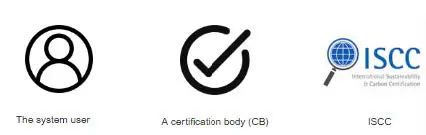
The system user selects the certification type relevant to their market and registers with an ISCC-recognized certification body. The CB conducts an audit, reports the findings to ISCC, and, if the company meets all requirements, issues the certificate. Various ISCC certificates are publicly available on the ISCC website and are valid for one year. ISCC also offers a competitive fee structure based on the company’s annual turnover.
The ISCC PLUS certification is available to a wide range of businesses across the supply chain, including:
Any company handling bio-based, circular, or recyclable materials can pursue ISCC PLUS certification to demonstrate sustainability and traceability in their business structure.
Here’s an example table of ISCC PLUS-certified companies or initiatives in Ireland, showing how the certification is being adopted to support circular and sustainable supply chains. While real-time data would require verification, the example below reflects the types of entities and industries typically involved.
| Company / Organization | Sector | ISCC PLUS Scope | Application |
|---|---|---|---|
| Kraton Polymers Ireland Ltd. | Chemicals / Polymers | Use of renewable feedstocks | Certified production of sustainable resins and adhesives |
| Novozymes Ireland | Biotechnology | Bio-based materials | Sustainable enzymes used in detergents and food processing |
| Celtic BioEnergy | Waste Management | Circular feedstocks | Processing organic waste into certified inputs for biofuels |
| INEOS Enterprises (Shannon) | Industrial Chemicals | Mass balance and bio-attribution | Certified sustainable chemical manufacturing |
| Glenisk (Hypothetical) | Food Production | Sustainable packaging materials | Use of bio-based plastics in yoghurt packaging |
| Irish Distillers (Pernod Ricard) | Beverages / Spirits | Circular economy in ethanol production | Use of sustainable agricultural by-products for alcohol distillation |
| Polymer Technology Ireland | Plastics / Packaging | ISCC PLUS support for recycled content verification | Industry association promoting sustainable supply chains |
ISCC PLUS is a globally recognised, voluntary certification system that ensures the sustainability and traceability of feedstocks across complex supply chains. It supports the circular economy and bioeconomy by certifying materials such as bio-based, recycled, and waste-derived inputs, helping businesses prove their commitment to sustainability and responsible sourcing.
ISCC PLUS supports the circular economy by certifying the use of waste, residues, and recycled materials as alternatives to virgin resources. It enables step-by-step traceability and sustainability verification throughout the supply chain—helping reduce environmental impact while maintaining production efficiency and material integrity.
The mass balancing method under ISCC PLUS allows certified sustainable materials to be tracked without physically separating them. This is ideal for industries like chemicals and plastics, where segregation is difficult. The total input and output of sustainable material must balance over a defined period, ensuring traceability and accountability.
ISCC PLUS offers three chain of custody options:
– Physical Segregation: 100% sustainable materials kept separate
– Controlled Blending: Certified and non-certified materials mixed, with ratio preserved
– Mass Balancing: Tracks sustainable inputs and outputs across systems, without physical segregation
These models give businesses flexibility while maintaining certified sustainability claims.
ISCC PLUS certification is open to any business that handles bio-based, circular, or recyclable materials, including:
– Raw material producers (e.g., farms, plantations)
– Chemical and plastic manufacturers
– Waste collectors and recyclers
– Retailers, traders, and distributors
– Packaging and food companies
This makes it applicable across the entire supply chain, from input to end-product.
Copyright © 2026. All Ireland Sustainability
Webdesign & Development Northern Ireland 2b:creative
Entries have now closed. We would love it if you could join us for our awards evening on the 1st of October 2026 at the Europa, Hotel, Belfast. Tables and tickets can be booked via the website.